Charleston Oyster Reef Restoration
- Carley

- Dec 2, 2023
- 4 min read
Updated: Jun 2, 2025
It is undeniably true that oysters serve a great purpose in our environment. With respect to their own homes, their neighbors, and our one home called Earth.
Oysters, eaten by my family regularly, were a big part of Native American culture as they were commonly found in the Chesapeake Bay, which used to be called Shellfish Bay by Natives. They went on to play huge roles in infrastructure development, trade, tourism, and mariculture. After European settlers arrives, demand increased and overharvesting began as environmental impact increased and natural population decreased.
Across the vast animal kingdom, Oysters can be found in the Mollusca phylum within a bigger superphylum called lophotrochozoans. This just means they possess special developmental features that help them survive and adapt to their environment.

Their phylum is the often considered the most diverse of the superphylum with 93,000+ species in it!
But for now, we will focus on one class called the bivalves. Specifically, the subclass Pteriomorphia within the class Bivalvia, where our oyster friends live<3
The Ostreidae family can be found around the world typically in shallow water with just the right salinity and temperature.

Now, we will refer to the Crassostrea virginica or the Eastern oyster found in Atlantic waters from Canada to Argentina.
The Pacific oyster, Crassostrea gigas is found from Japan to Washington state and as far south as Australia [1].
Oysters tend to cluster and stick to existing, often deceased, oysters during their early growth stages. The formation of oyster reefs is a direct outcome of their reproductive activities, contributing to the creation and expansion of these vital marine ecosystems.
Oysters are considered a keystone species for numerous reasons as they are self-repairing structures that channel currents, can filter near 50 gallons of water a day, stabilize bottom sediment, slow long-term erosion of the coastline, and maintain marine food chains by providing shelter and food sources for their friends above and below such as light sensitive grass beds.
Their shells are made from calcium and carbonate ions. This bit will be important later.
Oysters have a worldwide distribution and possess a high economic importance [2]. And without doubt, this has been heavily sought after by many in recent history as it has been found that 85% of oysters reef have been lost in the last 200 years mainly due to overharvesting of the species. Other pressing threats include habitat destruction, pollution, and disease, as the continuation of these threats can easily offput the recovery efforts in response to another.
With enough context to begin, I participated in an oyster reef restoration project in
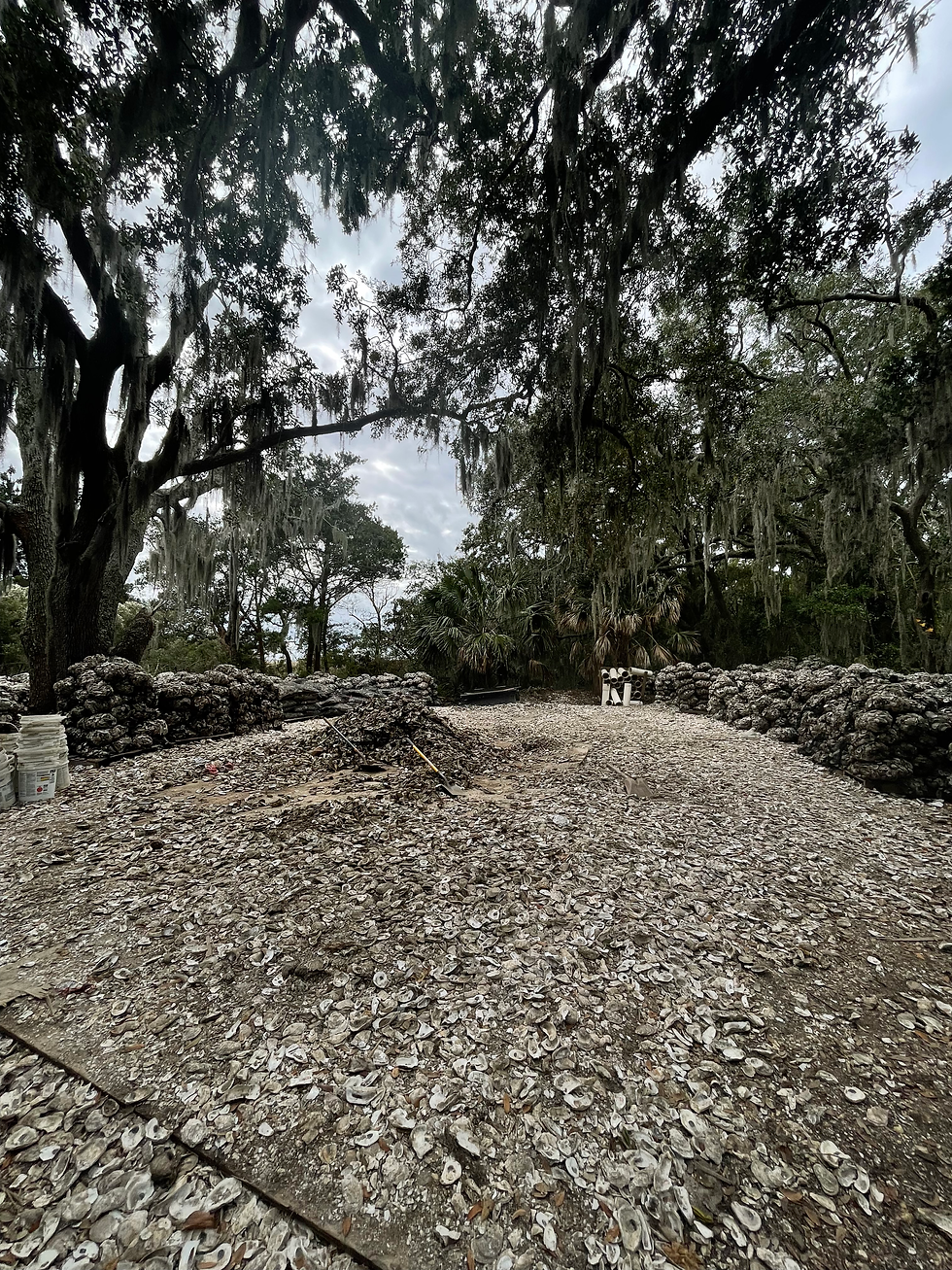
Charleston, South Carolina by the Coastal Conservation League of South Carolina in partnership with the South Carolina Department of Natural Resources. Here, we built 21 MWRs, or modular wire reefs, a design first pitched by the state's DNR in 2016 with aims to up oyster reef recruitment along the coastline [3].
Because crab traps are such a prevalent form of marine debris and seem to excite the oysters, the department began repurposing the debris with this objective, installing 47 RCT (repurposed crab traps) reefs in SC estuaries [3].
Soon after, they began using purpose-built plastic-free wire structures for oyster restoration with 3 goals in mind: easy construction, to meet minimum guidelines, and to increase oyster recruitment numbers.

Different methods of oyster reef restoration have been used throughout history, moving towards more sustainable and existing habit respecting methods today. However, those methods are not shown above in the photograph from my most recent restoration session.
Here, it is very important to consider the impacts that mining of resources and corrosion of materials have on water chemistry long-term.
For example, reef balls composed of substrates such as concrete and recycled shells are used in the Lafayette River. This concrete has a tremendously smaller impact on water quality than wire cages do. As do they last longer. Surely this cannot be all technology allows us, but it is a step forward.

As it is evident that stakeholders want to integrate oyster reef restoration with the fight against coastline erosion, it is important that we are implementing sustainable restoration practices, or our success could be likely to erode as well.
As stated before, oysters form their shells from calcium and carbonate ions found in the water. With 1/3 of our increasing carbon emissions going to the ocean, ocean acidification is expected to increase by 150% by the end of the 21st century [4].
As CO2 dissolves in seawater, it reacts with water to form carbonic acid (H2CO3). This acid can further dissociate into bicarbonate ions (HCO3-) and hydrogen ions (H+). The increase in hydrogen ions leads to a decrease in pH, making the water more acidic. These factors heavily affect oyster yield and key developmental stages.
Oysters are vital for marine ecosystems and the world, acting as keystone species and contributing to biodiversity. Despite their importance, oyster reefs have declined significantly, necessitating restoration efforts.
The choice of restoration methods is pivotal, considering the long-term impacts on water chemistry will help assure that the solution satisfies the system and not versus an individual gear.
Participating in this reef restoration project in South Carolina highlighted the need for eco-friendly approaches. With 85% of oyster reefs lost in the last two centuries, addressing overharvesting, pollution, and disease is just as important. As we combat coastline erosion, integrating sustainable practices ensures lasting success.
The looming threat of ocean acidification, driven by carbon emissions, poses challenges for oyster populations as well.

In recognizing the interconnectedness of oysters with our oceans, we embrace a collective responsibility to protect these ecosystems for future generations.
Citations
[1] Oysters | National Geographic (Date Accessed 2023, December 12)
[2] Salvi, Daniele & Macali, Armando & Mariottini, Paolo. (2014). Molecular Phylogenetics and Systematics of the Bivalve Family Ostreidae Based on rRNA Sequence-Structure Models and Multilocus Species Tree.
[3] Designing and utilizing modular wire structures to recruit oysters (Crassostrea virginica) for habitat enhancement and shoreline stabilization in coastal South Carolina. Greg Rothman, Graham Wagner, Gary Sundin & Peter Kingsley-Smith (Date Accessed 2023, December 12).
[4] Ocean Acidification | The United Nations Educational, Scientific and Cultural Organization. (Date Accessed 2023, December 12).

Comments